



 Hôtel Littéraire Gustave Flaubert, BW Signature Collection by Best Western
Unusual Places in Normandy in Summer: The Secrets That Guides Forget
Unusual places in Normandy in summer: the secrets that the guides forget
There exist in Madame Bovary magnificent descriptions of the Norman landscapes, the meadows, the hills, the forests, which illustrate the state of mind of the various characters in the novel, notably Emma. Flaubert’s Normandy is not a mere backdrop: it is a geography of the soul. And if one takes the trouble to traverse it against the tide of the July tourist flows, it reveals another aspect, capricious, wild, supremely beautiful.
In summer, millions of visitors crowd the same beaches, at the foot of the same cliffs when the sun is already too high. Yet, just a few kilometres away from the traffic jams and the selfies, Normandy keeps secrets admirably well concealed. Miniature ports lost in the moorlands of the Cotentin, wooded gorges that rival those of the Pyrenees, neo-futuristic gardens suspended above the Atlantic, and the alleys of Rouen where, in 1821, was born the man who would invent the modern novel.
This guide leads you along the byways of a region one believes to know, yet continually discovers anew.
I. The Secret Normandy of the Coast: Between Cap de la Hague and the Côte d'Albâtre
Port Racine, the smallest port in France
Nestled in the Saint-Martin cove at Saint-Germain-des-Vaux, on the western tip of the Cotentin peninsula, Port Racine is officially the smallest port in mainland France. Its dimensions are astonishingly precise: 800 m² in area, an opening between the two granite piers of merely 11 metres, and 27 berths reserved exclusively for vessels not exceeding 5.50 metres in length.
This haven owes its name to François-Médard Racine (1774-1817), one of the last Norman privateers active under Napoleon. In 1813, he chose the Anse Saint-Martin as a strategic refuge to anchor his schooner L'Embuscade, enabling him to attack English ships rounding the Cap de la Hague whilst remaining concealed from enemy patrols. The two present jetties were constructed between 1870 and 1886.
The site is reached via the GR 223, the Customs Officers' Path which runs along the entire Cotentin Peninsula from the Seine estuary to Mont-Saint-Michel. The surrounding landscapes, green moorlands plunging into a sea of ever-changing hues, cliffs preserved and protected by the Conservatoire du littoral, have earned the region the sobriquet of the « Petite Irlande ». These very landscapes inspired Jacques Prévert, who resided in the neighbouring village of Omonville-la-Petite during the final years of his life.
Access: Free of charge. Parking available at the hamlet of Landemer (free). Located 30 km from Cherbourg via the D901.
Étretat off-season: the magic of the quiet hours and the Jardins d'Étretat
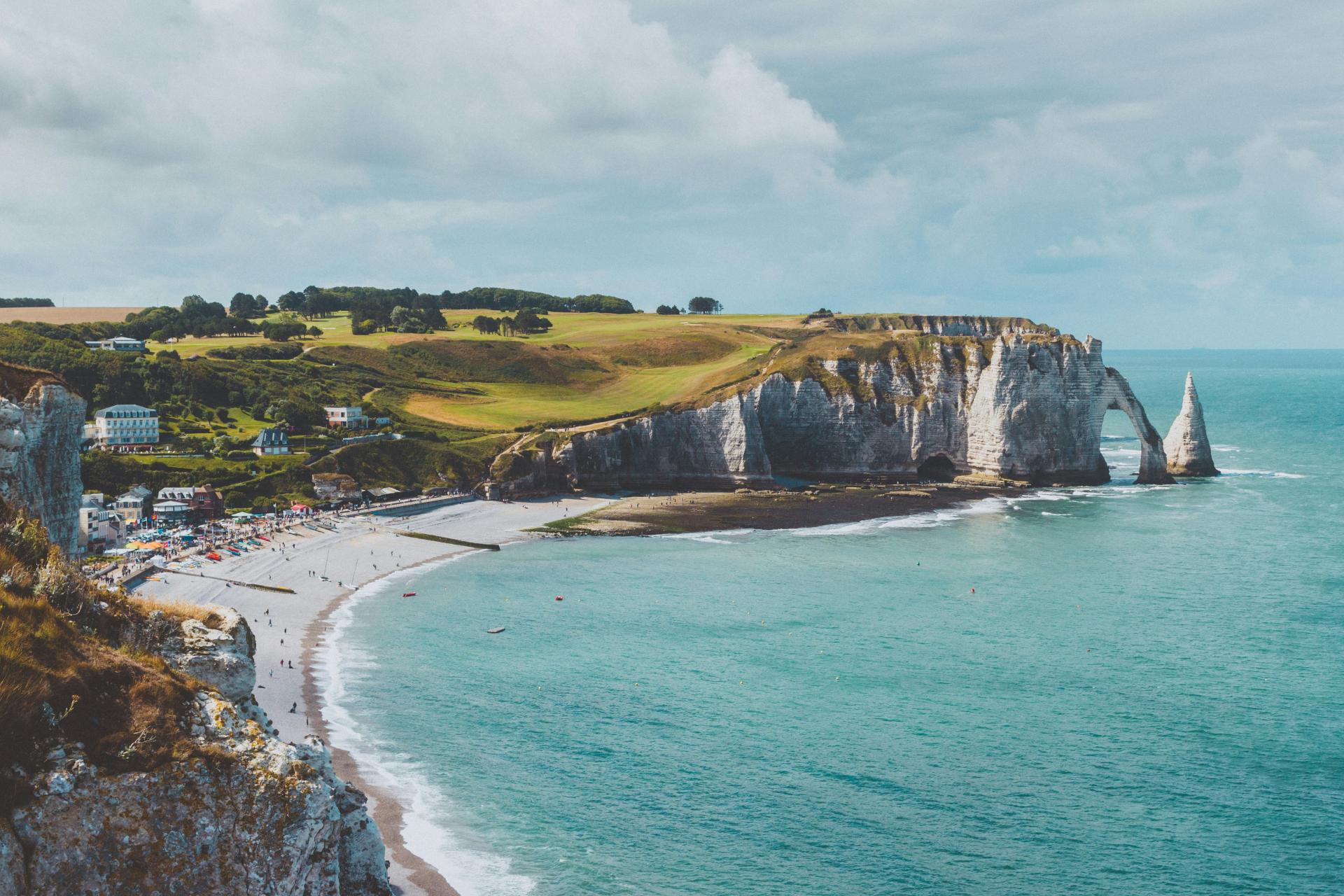
Everyone knows Étretat. Yet, everyone has seen it at the wrong hour. The period between 11 a.m. and 4 p.m. gathers the bulk of the 1.5 million annual visitors to the cliffs. Before 10 a.m. or after 5 p.m., the Aval and Amont cliffs regain their silence, and the low summer light of Normandy bathes them in an ivory hue that Claude Monet, between 1883 and 1885, endeavoured to capture in a series of paintings that have since become iconic.
What is less frequented, yet ought to be visited, are the Jardins d'Étretat (Avenue Damilaville, 76790 Étretat). Designated as a "Jardin remarquable" by the French Ministry of Culture, they unfold seven realms sculpted from neo-futurist topiaries, conceived by the architect Alexandre Grivko from 2016 onwards, blending over 150,000 plants with works of contemporary art. The view of the Aiguille Creuse from the garden’s heights is, according to many visitors, the most striking perspective, more intimate than that from the beach.
In July 2026, the Gardens shall also host Les Eaux Dormantes, a choreographic piece by the visual artist Marine Nouvel, as part of the Normandie Impressionniste festival (3rd, 4th, and 5th July 2026).
Rates: Adults from €12.90; group admission from €10 (minimum 20 persons, €11 in July-August). Open from 4 April to 1 November.
For an even more extraordinary experience, sea kayak excursions trace the cliffs up to the Porte d'Aval and the Aiguille Creuse, every Tuesday from 6 p.m. to 8 p.m. and every Saturday from 5:30 p.m. to 7:30 p.m., from April to September, departing from Étretat beach (Voiles et Galets d'Étretat, Rue Adolphe Boissaye, from €15 per hour of kayaking).
The garden of Jacques Prévert in Saint-Germain-des-Vaux
Two kilometres from Port Racine, upon the heights of Saint-Germain-des-Vaux, an extraordinary garden pays tribute to Jacques Prévert. Created in 1987 by Gérard Fusberti, a friend of the poet, it hosts trees planted by eminent figures of the era—Yves Montand, Boris Vian, Juliette Gréco, Pablo Picasso—in posthumous homage to the author of *Paroles*. In 2004, it was awarded the distinction of « Jardins remarquables ». The poet’s texts adorn the flowerbeds throughout the seasons.
A few metres away, the house of Jacques Prévert in Omonville-la-Petite is open to visitors free of charge. The writer spent the final years of his life there, having settled there permanently only six years before his death in 1977, where he found again the ocean, the rocks, and the ever-changing light of La Hague. His partially reconstructed studio and his grave in the small communal cemetery offer a modest and moving stop, standing in stark contrast to mass tourism.
II. The Overlooked Landscapes: la Suisse Normande, Vertical Normandy
La Roche d'Oëtre and the gorges of the Rouvre
That Normandy is flat is one of the most persistent misconceptions. Forty minutes south of Caen, straddling the Calvados and Orne departments, the Suisse Normande presents landscapes that astonish even the most seasoned travellers.
At the heart of this region, the Roche d'Oëtre (Saint-Philbert-sur-Orne) is a protected rocky promontory, several million years old, rising 118 metres above the wooded gorges of the Rouvre. It is one of the most spectacular viewpoints in Western France, and one of the few inland cliffs in Normandy.
The marked trails allow one to explore the gorges from below (sentier des gorges, 2.5 km) or from the heights (sentier des méandres, 6 km). In summer, the dense vegetation of the gorges provides a welcome coolness, the temperature being noticeably lower than in the plains.
Access: Paid site with parking, restaurant, local produce shop, and an adventure park on the premises. Located 40 km south of Caen.
Clécy and the via ferrata along the banks of the Orne
In the village of Clécy, regarded as the capital of Suisse Normande, the Rochers des Parcs present an accessible climbing experience, and the vistas over the Orne valley rank among the most splendid in the region. The via ferrata along the banks of the Orne, just beyond Clécy, offers a vertical adventure upon the precipitous cliffs of the river, suitable for all levels.
It is also here that, in summer, the unique light of Normandy gently settles upon the beeches and oaks with a generosity that invites one to slow down. One may stroll through the old Clécy, visit the museum of the impressionist painter Hardy, or discover one of the largest miniature railway models in Europe, housed in the village’s former station.
The Orne by canoe-kayak from Pont-d'Ouilly
The Orne, the largest Norman river after the Seine according to the Fédération vélofrancette, winds its way through the rock to offer an exceptional playground for kayakers. (Source: La Vélo Francette.) From Pont-d'Ouilly, canoe and kayak descents are organised at the local outdoor centres. The Orne valley can also be explored by pedal boat or electric boat from Clécy.
The spectacle of the meanders viewed from the water, nestled between wooded cliffs and Norman meadows, is an experience unparalleled elsewhere in the region. For those who delight in heights, paragliding and hang gliding are practised from the Pain de sucre (214 metres above sea level), another summit of the Suisse Normande.
III. Literary Normandy: the places Flaubert traversed without naming them
The geography of Flaubert's oeuvre is distinctly Norman. He was born in Rouen in 1821, spent his childhood a few kilometres from the city centre, sojourned in Trouville from his adolescence, and composed the greater part of his work at his estate in Croisset, on the banks of the Seine. To explore Normandy through his eyes is to overlay two maps: the one visible to the eye, and the one that literature has rendered eternal.
Croisset, the house of the hermit of the Seine
In Canteleu, a few kilometres from Rouen, stood the grand manor house of Croisset where Flaubert resided for nearly 35 years until his death in 1880. The building itself was demolished at the end of the nineteenth century, but the garden pavilion where the writer worked has been preserved and transformed into a museum. It houses objects that belonged to the author—quill pens, inkwells, writing furniture—and a recent restoration has made the site accessible to the public.
Address: 18, quai Gustave Flaubert, 76380 Canteleu. Contact: 02 76 08 80 88.
Trouville-sur-Mer, the cradle of the novelist
The beach of Trouville is where Flaubert, from the tender age of fourteen, experienced his first summer holidays. It was there, in 1836, that he met Élisa Schlésinger, who became his most enduring passion and inspired the character of Mme Arnoux in L'Éducation sentimentale.
He would sojourn in Trouville on fifteen occasions throughout his life. In one of his letters to Louise Colet (1846), he writes that his most cherished youthful memories are entwined with the sunsets at Trouville by the seaside.
Trouville-sur-Mer may now be visited in a single day from Rouen. The town has preserved, within its plank-lined streets and fish market, a certain essence of Normandy that Flaubert cherished: popular, briny, and tinged with a gentle melancholy.
Rouen, the living heart of a Normandy yet to be written
Rouen is the city that gave birth to Flaubert, yet he seldom returned the favour. In his correspondence, he alternately dubs it his « stupide patrie » and « l'infect Rouen ».
Yet, he always returns to it. And Rouen of today truly merits such a return. Its old timber-framed town, the Place du Vieux-Marché where Jeanne d'Arc was burned, the Gros-Horloge, the cathedral to which Monet devoted a series of thirty paintings—all these compose a historical backdrop of rare density.
It is in this very heart of the city, at 33 rue du Vieux Palais, that one finds the Hôtel Littéraire Gustave Flaubert, a distinguished 4-star establishment of the Société des Hôtels Littéraires. Its 51 rooms, each uniquely adorned in homage to the characters and settings of Flaubert’s oeuvre — Emma Bovary, Frédéric Moreau, Mégara, Guy de Maupassant —, its international library boasting over 500 volumes, the original editions displayed at the entrance, the boudoir of Madame Bovary, and its summer terrace collectively render it an ideal starting point from which to explore the lesser-known charms of Normandy. Breakfast, served each morning as a buffet featuring local produce and homemade delicacies, may in summer be enjoyed upon the terrace.
From the hotel's pedestrian street, the Place du Vieux-Marché is but a two-minute walk away. The Musée Flaubert et d'Histoire de la Médecine, housed in the Hôtel-Dieu where the writer was born, lies less than a quarter of an hour distant. And Rouen station, the departure point for Étretat, Trouville, or the Suisse Normande, is but a few stops away.
To extend the literary sojourn beyond Normandy, the collection of Hôtels Littéraires also includes the Hôtel Littéraire Arthur Rimbaud in Paris (10th arrondissement), the Hôtel Littéraire Marcel Aymé in Montmartre (18th arrondissement), the Hôtel Littéraire Alexandre Vialatte in Clermont-Ferrand, and the Hôtel Littéraire Stendhal in Nancy.
FAQ — Frequently Asked Questions
What are the unusual places to visit in Normandy during the summer? Among the less frequented yet remarkable sites are: Port Racine (Saint-Germain-des-Vaux), the smallest port in France located in the Cotentin; the Jardins d'Étretat, contemporary gardens awarded the label « Jardin remarquable » overlooking the cliffs; the Roche d'Oëtre in Suisse Normande (118 m, gorges de la Rouvre); and the house of Jacques Prévert in Omonville-la-Petite.
How to avoid the crowds at Étretat in July and August? Normandie Tourisme advises visiting the cliffs before 10 a.m. or after 5 p.m. The period between 11 a.m. and 4 p.m. sees the greatest number of visitors. An evening sea kayaking excursion (Tuesdays and Saturdays, from April to September) also offers the opportunity to view the cliffs from the sea, away from the throngs.
Where exactly is La Suisse Normande? La Suisse Normande is a natural region straddling the départements of Calvados and Orne, situated forty minutes south of Caen. It stretches from Le Hom to Putanges-le-Lac. Its highest point, the Pain de sucre, rises to 214 metres.
Is it possible to visit the Flaubertian sites in Normandy? Indeed. The Pavillon de Croisset (Canteleu, 18 quai Gustave Flaubert) preserves the writer’s belongings. Trouville-sur-Mer, Pont-l'Évêque, and Honfleur are connected to *Un cœur simple*. Rouen (Musée Flaubert, place du Vieux-Marché, cathedral) is within walking distance from the city centre.
Where to stay in Rouen to explore the unusual Normandy? The Hôtel Littéraire Gustave Flaubert (33 rue du Vieux Palais, Rouen) is a 4-star establishment ideally situated in the historic heart, just two minutes from the place du Vieux-Marché. Its rooms, uniquely themed around Flaubert’s work, and its library of 500 volumes make it an ideal starting point for excursions to Étretat, Trouville, and the Suisse Normande.
The unusual Normandy of summer is not found on road signs. It must be earned somewhat: one must rise before the crowds to hear the pebbles of Étretat rolling beneath the waves with no witness but the seagulls, one must descend the steep path of Landemer to Port Racine to understand that the smallest port in the world is sometimes the grandest of landscapes.
Flaubert, he knew it well. He always returned to Normandy — despite his protests, despite his complaints about the weather and the inhabitants. For it was here that something within him breathed differently. That Normandy, the one beyond the beaten paths, still stands firm.
Sources
Cotentin Tourisme – Port Racine: Port Racine: the Smallest Port in France | Cap de la Hague
Normandie Tourisme – Étretat : https://www.normandie-tourisme.fr/les-incontournables/etretat/
Normandie Tourisme – In the Footsteps of Prévert: https://www.normandie-tourisme.fr/prevert-cotentin/
Normandie Tourisme – In the Footsteps of Flaubert: https://www.normandie-tourisme.fr/lieux-gustave-flaubert/
Jardins d'Étretat (official site) : https://etretatgarden.fr/
Jardins d'Étretat – Ticket Office: Ticket Office | Jardins d'Etretat, France, Normandy
Falaise – Suisse Normande Tourism: https://www.falaise-suissenormande.com/sites-naturels/la-roche-doetre-et-les-gorges-de-la-rouvre/
La Vélo Francette – Suisse Normande: https://www.lavelofrancette.com/decouvrir/incontournables/suisse-normande
Gallimard – Flaubert, itinerary of a Norman writer : https://www.gallimard.fr/catalogue/flaubert-itineraire-d-un-ecrivain-normand/9782072930317
France.fr – Discovering Normandy through Flaubert : Discovering Normandy through Flaubert
Flaubert 21 – Flaubert and Normandy: http://flaubert21.fr/fr/flaubert-rouen-normandie
Findweek – Unusual Activities Étretat: Create your tailor-made weekend destination Étretat
Société des Hôtels Littéraires: https://www.hotelslitteraires.fr/
Hôtel Littéraire Gustave Flaubert: https://www.hotelgustaveflaubert.com/fr/
Written by Léa Geoffray